

President Bola Ahmed Tinubu has defended his administration’s decision to remove the petrol subsidy, insisting that the Nigerian currency could have become virtually worthless if the policy had remained in place.
The President also ruled out any possibility of restoring the subsidy, declaring that Nigeria must continue with the economic reforms introduced by his government.
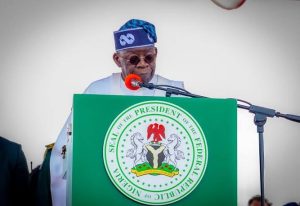
Tinubu made the remarks on Friday, November 6, 2026, during a state reception organised in his honour at the newly constructed Banquet Hall of ARISE Palm Resort in Uyo, Akwa Ibom State.
The reception followed an All Progressives Congress (APC) rally held at the Godswill Akpabio International Stadium.

Speaking at the event, the President said the country was facing serious financial difficulties when he assumed office, claiming that 27 of the 36 state governors were struggling to meet their salary obligations, with pension and gratuity payments also posing significant challenges.
He argued that the economic situation could have deteriorated further if his administration had failed to take what he described as difficult but necessary decisions.
Tinubu said: “By now, if we didn’t take a decision, the day I took over, we would use wheelbarrows to move our naira. Because it would have been valueless, nothing.”
The President placed the exchange rate at approximately ₦1,300 to the United States dollar and maintained that the naira had retained some purchasing power as a result of the economic measures introduced by his administration.
He insisted that reversing the fuel subsidy removal would take the country backwards and declared that Nigeria would not return to the policy.
Drawing a comparison with the biblical account of Moses leading the Israelites out of Egypt, Tinubu urged Nigerians to remain committed to the direction his administration had chosen.
“Nigeria will never go back to the subsidy,” he declared.
The President also used the occasion to criticise opposition presidential candidates Peter Obi and Atiku Abubakar, questioning their records and political decisions.
Tinubu also took aim at Atiku Abubakar, the presidential candidate of the African Democratic Congress (ADC), accusing him of abandoning the Peoples Democratic Party when his leadership came under challenge.
The President argued that the political decisions and records of the opposition figures should form part of the considerations Nigerians make when assessing those seeking to lead the country.
On education, Tinubu acknowledged the financial difficulties facing Nigerian families and said his administration was working to expand access to learning by reducing the financial burden associated with tuition fees.
He described education as an important instrument for tackling poverty and creating opportunities for younger generations.
“Equal opportunity for everybody who wants to read. Taking education as the greatest weapon against poverty. And creating opportunities for those who are still coming behind,” he said.
Tinubu further announced that funds recovered by the Economic and Financial Crimes Commission (EFCC) would be channelled into the government’s education programme.
“From today on, as we are fighting corruption, any money recovered from EFCC is dumped into that education program. No one can reverse it,” he stated.
The President presented the proposed arrangement as part of his administration’s commitment to expanding educational opportunities and ensuring that recovered proceeds of corruption contribute to national development.
He also appealed to residents of Akwa Ibom State to support his government, while renewing his commitment to helping actualise the Ibom Deep Seaport project.
The proposed seaport is regarded as an important infrastructure initiative for Akwa Ibom, with the potential to strengthen maritime activities, trade and investment in the South-South region.
Tinubu‘s remarks came amid continuing public debate over the impact of fuel subsidy removal, exchange-rate reforms and the rising cost of living on Nigerian households and businesses.