


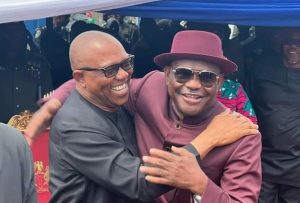
The Minister of the Federal Capital Territory (FCT), Nyesom Wike, has criticised the presidential candidate of the Nigeria Democratic Congress (NDC), Peter Obi, over an alleged refusal to stand during the singing of Nigeria’s national anthem at a recent gathering in Lagos.
Wike described the alleged action as an indication of lawlessness and questioned Obi’s commitment to Nigeria’s unity, arguing that anyone seeking to become the country’s president should demonstrate respect for its national symbols.
Speaking on the controversy, the FCT minister alleged that Obi remained seated while the Nigerian national anthem was being performed but stood up when a different anthem, which is not officially recognised as Nigeria’s national anthem, was sung.
Wike argued that the alleged conduct raised questions about Obi’s sense of national identity and his commitment to preserving the unity of the country.

He said:
“A whole national anthem of a country is being sung. A man who wants to be President of Nigeria would disobey and sit down. And then not only that, when a different national anthem that is not being used for Nigeria was sung, he stood up.
“In a way, he does not belong to this country. In a way, he has said he does not belong to this country; that if you give him the president, he would do a different thing that will divide Nigeria.”
The minister further argued that anyone who allegedly disregards the country’s national symbols should not be allowed to occupy the highest political office in the country.
According to Wike, respect for the national anthem represents an important demonstration of patriotism and loyalty to Nigeria.
He added:
“A man who does not believe in Nigeria, someone who derives joy in ridiculing the country by disrespecting its symbolic National Anthem must not be allowed to come near the presidency of our country.”
Wike‘s comments have added to the political exchanges surrounding Peter Obi and his presidential ambition, particularly as questions of national unity, patriotism and political leadership continue to feature in the country’s political discourse.